

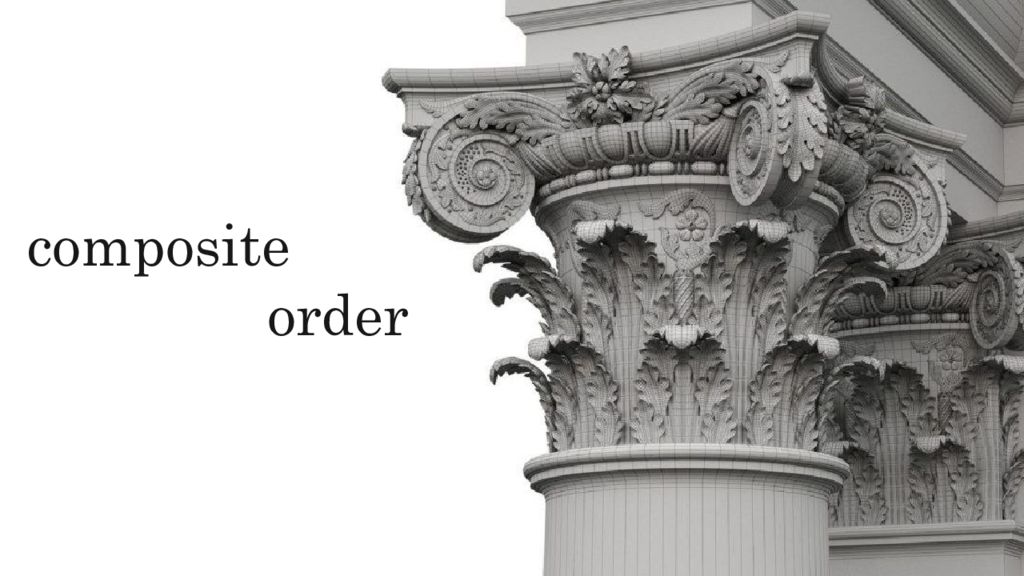
composite order

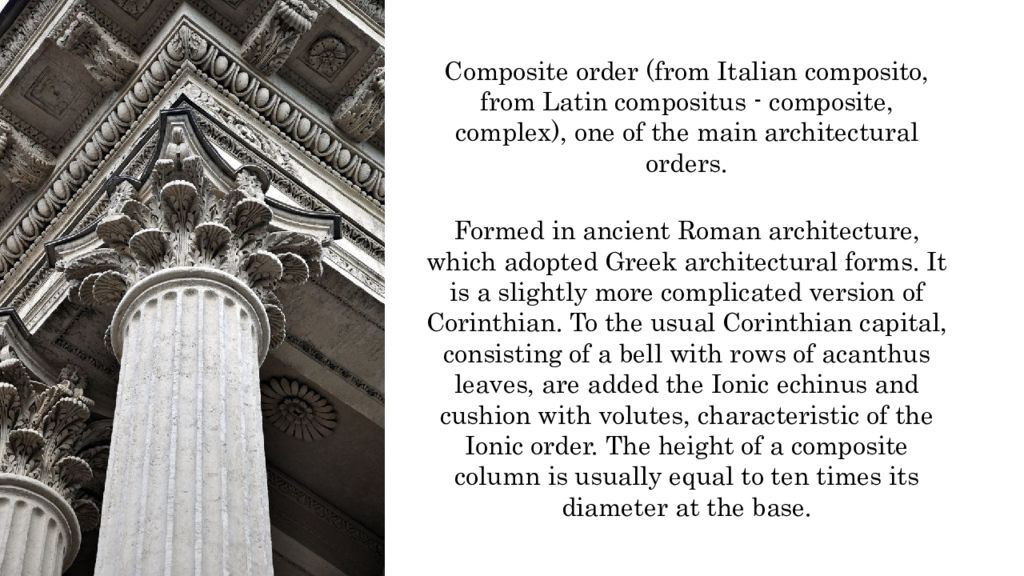
Composite order (from Italian composito, from Latin compositus - composite, complex), one of the main architectural orders. Formed in ancient Roman architecture, which adopted Greek architectural forms. It is a slightly more complicated version of Corinthian. To the usual Corinthian capital, consisting of a bell with rows of acanthus leaves, are added the Ionic echinus and cushion with volutes, characteristic of the Ionic order. The height of a composite column is usually equal to ten times its diameter at the base.
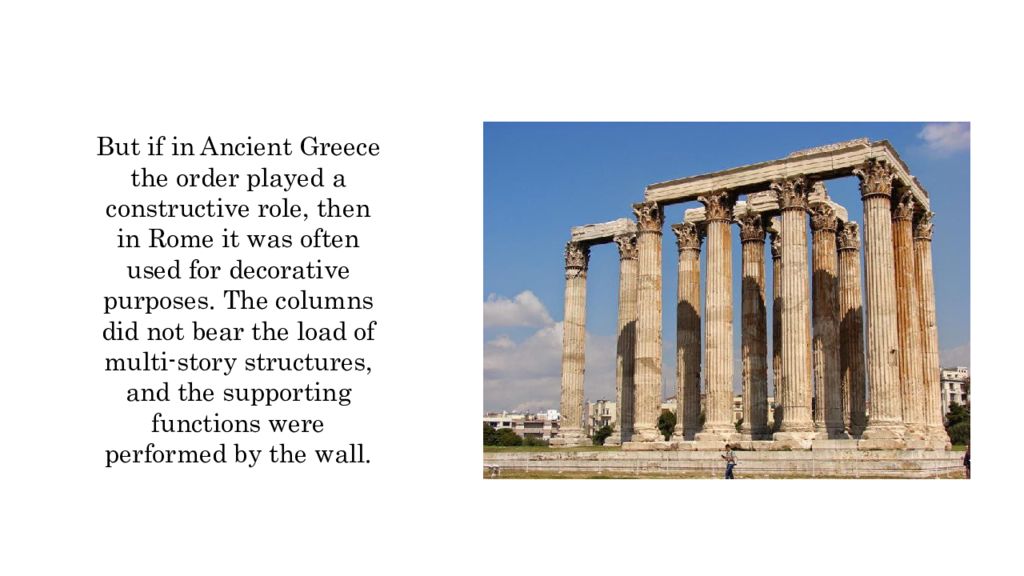
But if in Ancient Greece the order played a constructive role, then in Rome it was often used for decorative purposes. The columns did not bear the load of multi-story structures, and the supporting functions were performed by the wall.
A. Palladio. Four books about architecture. 1570. Composite order J.B. Vignola. The rule of five orders of architecture. 1562. Composite order In the era of the Italian Renaissance, Sebastiano Serlio in the book "General Rules of Architecture" (ital. Regole generali d'architettura) (1537), and then Giacomo Barozzi da Vignola in the treatise "The Rule of the Five Orders of Architecture" (1562) included the composite order among the five classical ones: Doric, Tuscan, Ionic, Corinthian and composite. In Vignola's treatise, the composite order is identical in proportions to the Corinthian, differing only in the capital and entablature[4]. Andrea Palladio in his treatise "Four Books on Architecture" (1570) showed an entablature of a composite order with a convex frieze.

The Romans began to complicate the composite capital with outlandish sculptural details with images of griffins, centaurs, and hippocamps. If the Corinthian capital resembles a bouquet, or a basket with leaves, then the composite one can be called a combination of a botanical garden and a bestiary (menagerie) in one basket.

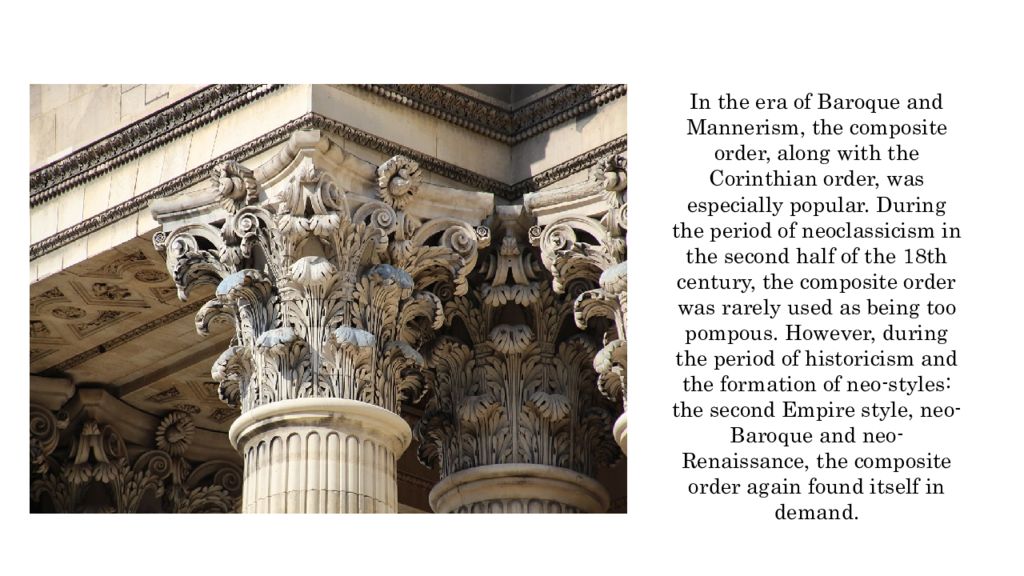
In the era of Baroque and Mannerism, the composite order, along with the Corinthian order, was especially popular. During the period of neoclassicism in the second half of the 18th century, the composite order was rarely used as being too pompous. However, during the period of historicism and the formation of neo-styles: the second Empire style, neo-Baroque and neo-Renaissance, the composite order again found itself in demand.
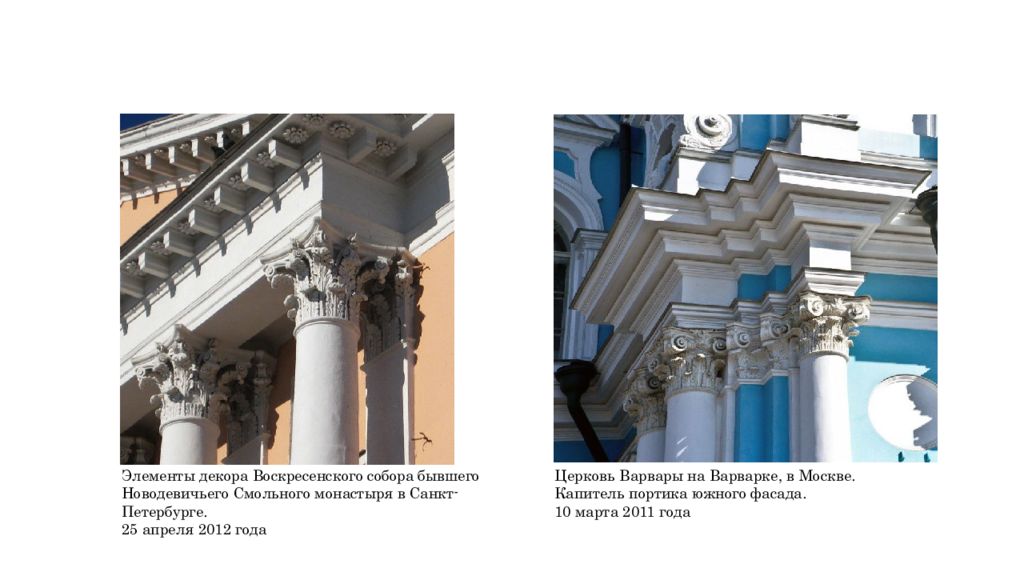
Элементы декора Воскресенского собора бывшего Новодевичьего Смольного монастыря в Санкт-Петербурге. 25 апреля 2012 года Церковь Варвары на Варварке, в Москве. Капитель портика южного фасада. 10 марта 2011 года
completed: Nabiev Sh.Sh I thank the audience for your kind attention. I thank the audience for your kind attention.