

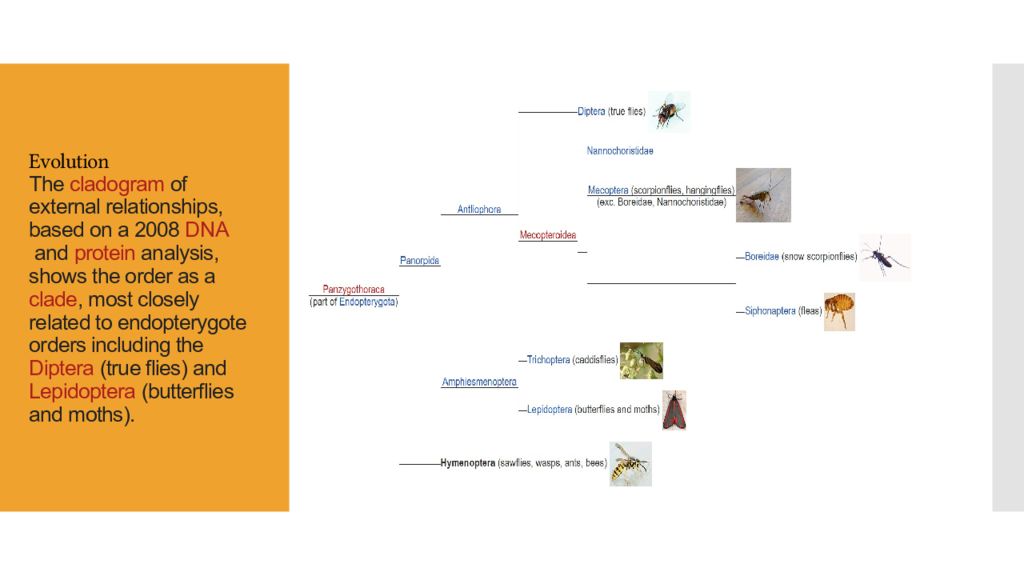
![Hymenoptera originated in the Triassic, with the oldest fossils belonging to the family Xyelidae. Social hymenopterans appeared during the Cretaceous. [11]](https://s1.showslide.ru/s_slide/1a55/fa7e1d04-5be6-4454-8549-558264fda75e.jpeg.webp "Hymenoptera")



Hymenoptera is a large order of insects, comprising the sawflies, wasps, bees, and ants. Over 150,000 living species of Hymenoptera have been described, [2] [3] in addition to over 2,000 extinct ones. [4] Many of the species are parasitic. Females typically have a special ovipositor for inserting eggs into hosts or places that are otherwise inaccessible. This ovipositor is often modified into a stinger. The young develop through holometabolism (complete metamorphosis )—that is, they have a wormlike larval stage and an inactive pupal stage before they mature.
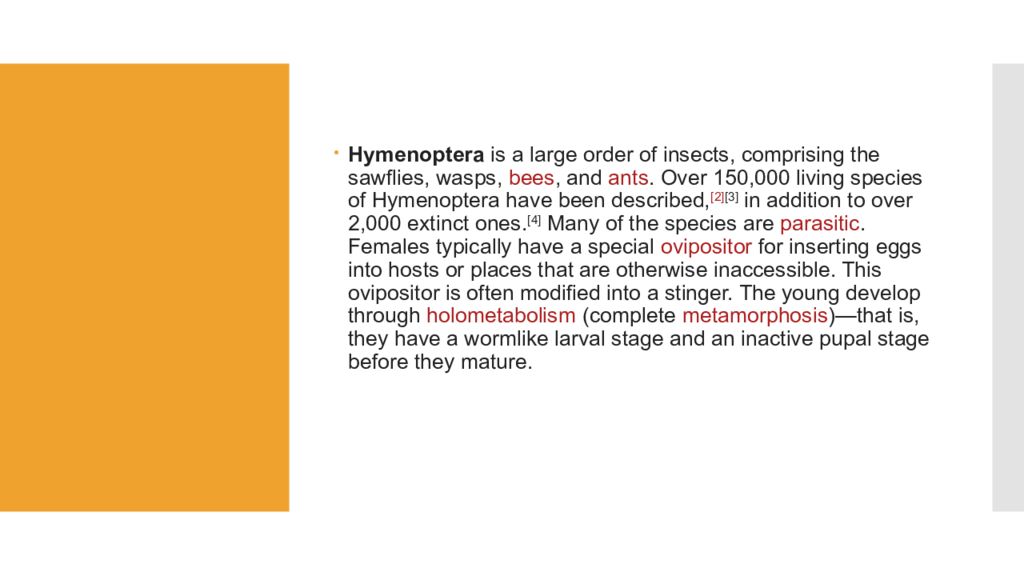
The name Hymenoptera refers to the wings of the insects, but the original derivation is ambiguous. [5] : 42 All references agree that the derivation involves the Ancient Greek π τερόν ( pteron ) for wing. [6] The Ancient Greek ὑμήν ( hymen ) for membrane provides a plausible etymology for the term because species in this order have membranous wings. [6] However, a key characteristic of this order is that the hindwings are connected to the forewings by a series of hooks. Thus, another plausible etymology involves Hymen, the Ancient Greek god of marriage, as these insects have married wings in flight. Another suggestion for the inclusion of Hymen is the myth of Melissa, a nymph with a prominent role at the wedding of Zeus.
![Hymenoptera originated in the Triassic, with the oldest fossils belonging to the family Xyelidae. Social hymenopterans appeared during the Cretaceous. [11]](https://s1.showslide.ru/s_slide/1a55/fa7e1d04-5be6-4454-8549-558264fda75e.jpeg "Hymenoptera")
Hymenopterans range in size from very small to large insects, and usually have two pairs of wings. Their mouthparts are adapted for chewing, with well-developed mandibles ( ectognathous mouthparts). Many species have further developed the mouthparts into a lengthy proboscis, with which they can drink liquids, such as nectar. They have large compound eyes, and typically three simple eyes. The forward margin of the hind wing bears a number of hooked bristles, or " hamuli ", which lock onto the fore wing, keeping them held together. The smaller species may have only two or three hamuli on each side, but the largest wasps may have a considerable number, keeping the wings gripped together especially tightly. Hymenopteran wings have relatively few veins compared with many other insects, especially in the smaller species.
Diet Different species of Hymenoptera show a wide range of feeding habits. The most primitive forms are typically phytophagous, feeding on flowers, pollen, foliage, or stems. Stinging wasps are predators, and will provision their larvae with immobilised prey, while bees feed on nectar and pollen. A huge number of species are parasitoids as larvae. The adults inject the eggs into a host, which they begin to consume after hatching. For example, the eggs of the endangered Papilio homerus are parasitized at a rate of 77%, mainly by Hymenoptera species. [28] Some species are even hyperparasitoid, with the host itself being another parasitoid insect. Habits intermediate between those of the herbivorous and parasitoid forms are shown in some hymenopterans, which inhabit the galls or nests of other insects, stealing their food, and eventually killing and eating the occupant.
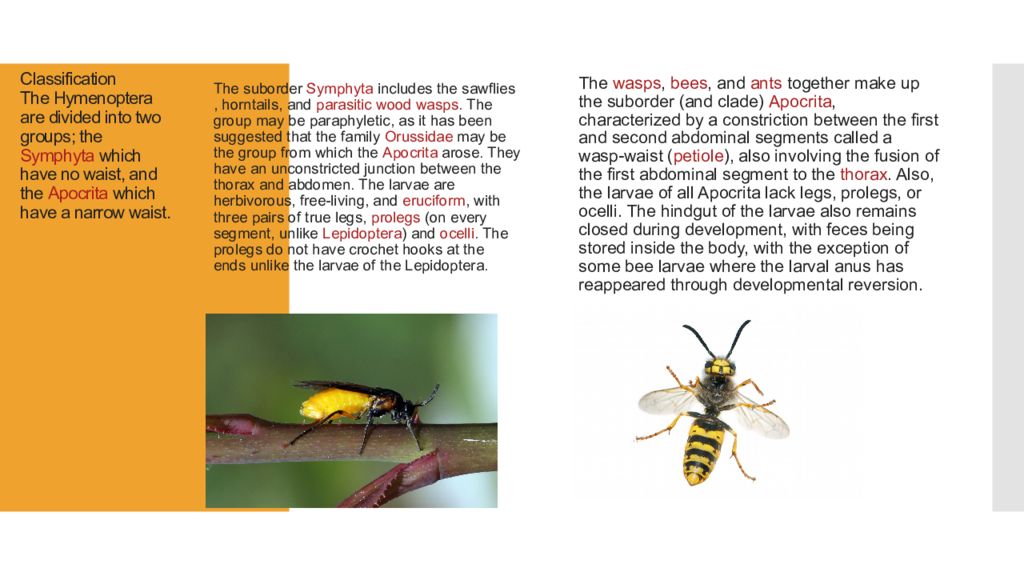
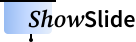
The suborder Symphyta includes the sawflies, horntails, and parasitic wood wasps. The group may be paraphyletic, as it has been suggested that the family Orussidae may be the group from which the Apocrita arose. They have an unconstricted junction between the thorax and abdomen. The larvae are herbivorous, free-living, and eruciform, with three pairs of true legs, prolegs (on every segment, unlike Lepidoptera ) and ocelli. The prolegs do not have crochet hooks at the ends unlike the larvae of the Lepidoptera. The wasps, bees, and ants together make up the suborder (and clade) Apocrita, characterized by a constriction between the first and second abdominal segments called a wasp-waist ( petiole ), also involving the fusion of the first abdominal segment to the thorax. Also, the larvae of all Apocrita lack legs, prolegs, or ocelli. The hindgut of the larvae also remains closed during development, with feces being stored inside the body, with the exception of some bee larvae where the larval anus has reappeared through developmental reversion.