


Lecture 1
What is science in general ? Importance of science in everyday life. The role of science in society. General remarks concerning science. Branches of science. Distinctive features of science. Table of Content
To understand what science is, just look around you. What do you see? Perhaps your hand on the mouse, a computer screen, papers, ballpoint pens, the family cat, the sun shining through the window …. Science is, in one sense, our knowledge of all that — all the stuff that is in the universe, including the tiniest subatomic particles in a single atom of the metal in your computer’s circuits, the nuclear reactions that formed the immense ball of gas that is our sun, and the complex chemical interactions and electrical fluctuations within your own body that allow you to read and understand these words. But science is not just a collection of knowledge. Just as importantly, science is also a reliable process by which we learn about all that stuff in the universe. And science is different from many other ways of learning because of the way it is done. Science relies on testing ideas with evidence gathered from the natural world. What is Science?
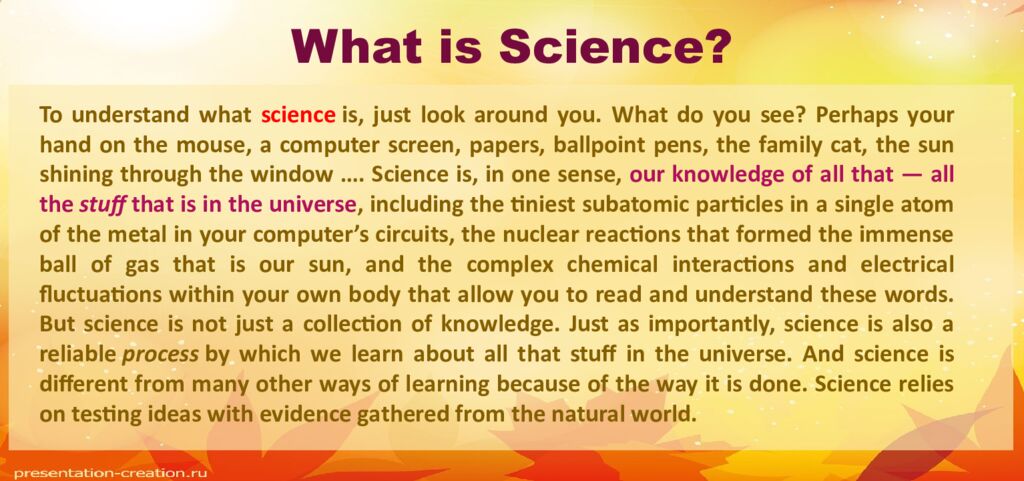
Science helps to satisfy the natural curiosity with which we are all born: Why is the sky blue? How did the leopard get its spots? What is a solar eclipse? With science, we can answer such questions without resorting to magical explanations. And science can lead to technological advances, as well as helping us learn about enormously important and useful topics, such as our health, the environment, and natural hazards. Without science, the modern world would not be modern at all. Still, we have so much to learn. Millions of scientists all over the world are working to solve different parts of the puzzle of how the universe works, peering into its nooks and crannies and deploying their microscopes, telescopes, and other tools to unravel its secrets. What is Science?
Science is complex and multi-faceted, but the most important characteristics of science are straightforward: Science is a way of learning about what is in the natural world, how the natural world works, and how the natural world got to be the way it is. It is not simply a collection of facts; rather it is a path to understanding. Science focuses exclusively on the natural world and does not deal with supernatural explanations. What is Science?
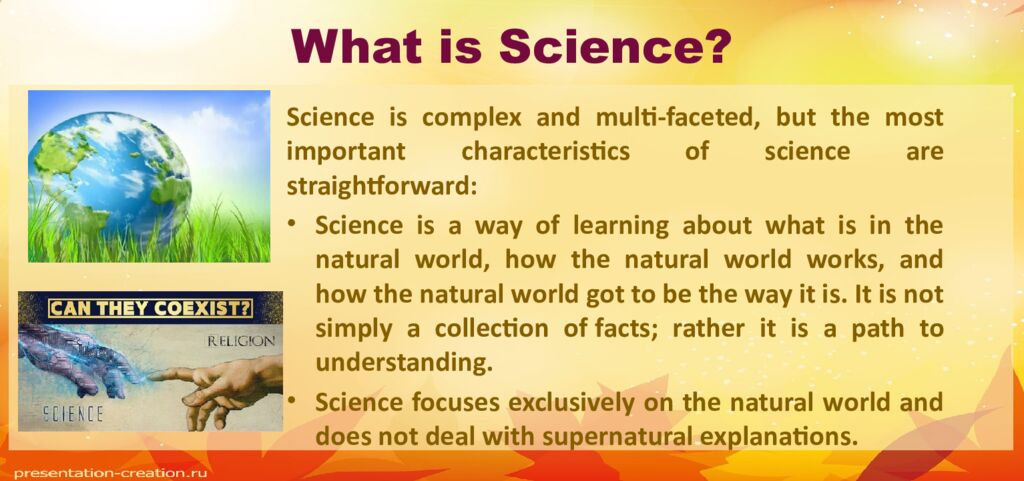
Although scientists work in many different ways, all science relies on testing ideas by figuring out what expectations are generated by an idea and making observations to find out whether those expectations hold true. Accepted scientific ideas are reliable because they have been subjected to rigorous testing. But, as new evidence is acquired and new perspectives emerge, these ideas can be revised. Science is a community endeavor. It relies on a system of checks and balances, which helps ensure that science moves in the direction of greater accuracy and understanding. This system is facilitated by diversity within the scientific community, which offers a broad range of perspectives on scientific ideas. What is Science?
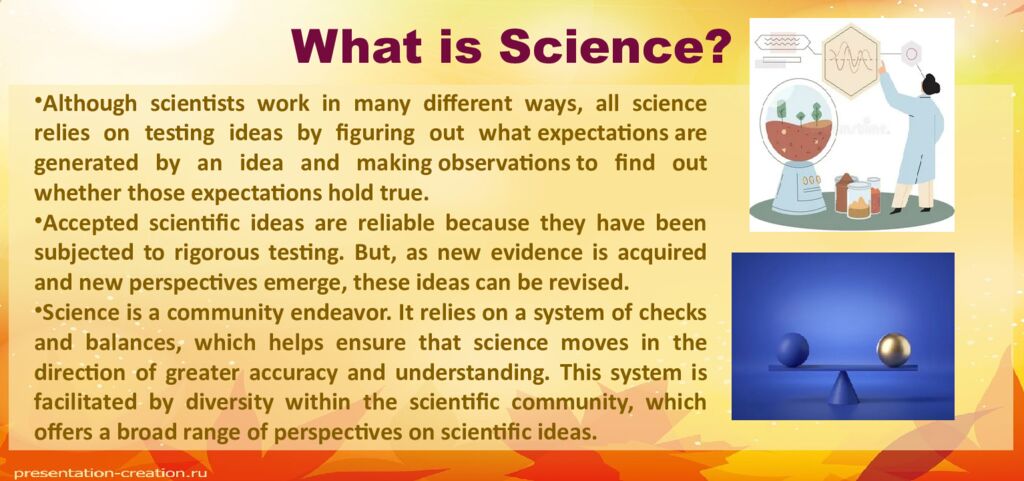
Science is a part of our everyday life. In its broadest meaning science means 'knowledge'. And, as knowledge, it had entered life of even the most primitive human beings. They knew, in protein and carbohydrate and containing vitamins. The result is a healthy prolonged life. One can imagine how life must have been in pre-scientific days. Science has also improved clothing and made it more appropriate for climatic and working conditions. Man-made fibers and versatile spinning machines, today enable us to dress in clothes both comfortable and smart without being expensive Importance of science in everyday life
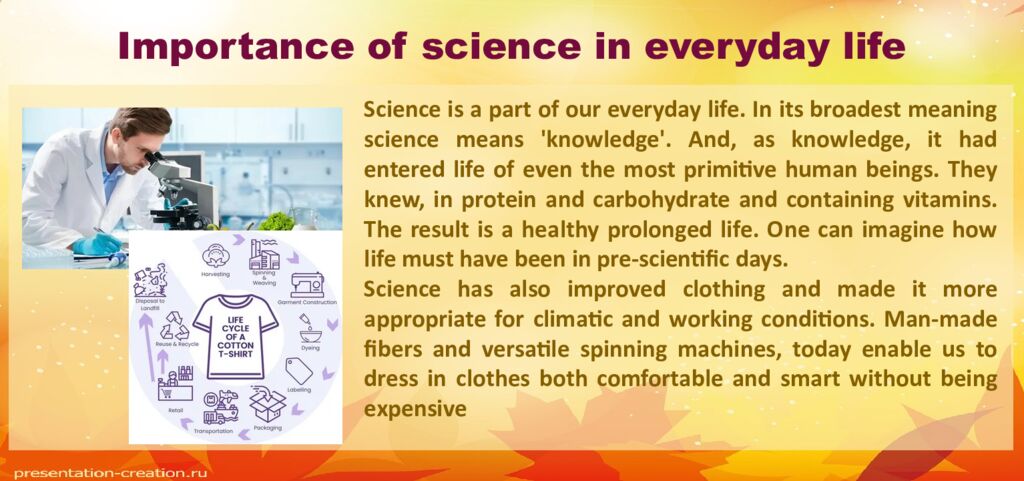
We can't think of our everyday life without science. For instance, the safe from the poisonous berry. They knew some rudimentary ideas about building a hut, sharpening a spear, and fishing in the river. This is what is science which distinguishes man from the animals which rely on their instinct.Yet, for most people 'science' means a number of abstract subjects such as physics, chemistry, biology and mechanics, to quote a few, which have to be learnt as part of 'education', yet which seem to have little bearing on everyday living. This is all wrong. Our way of life is completely dependent on science and its inventions and discoveries surround us on all sides. Importance of science in everyday life
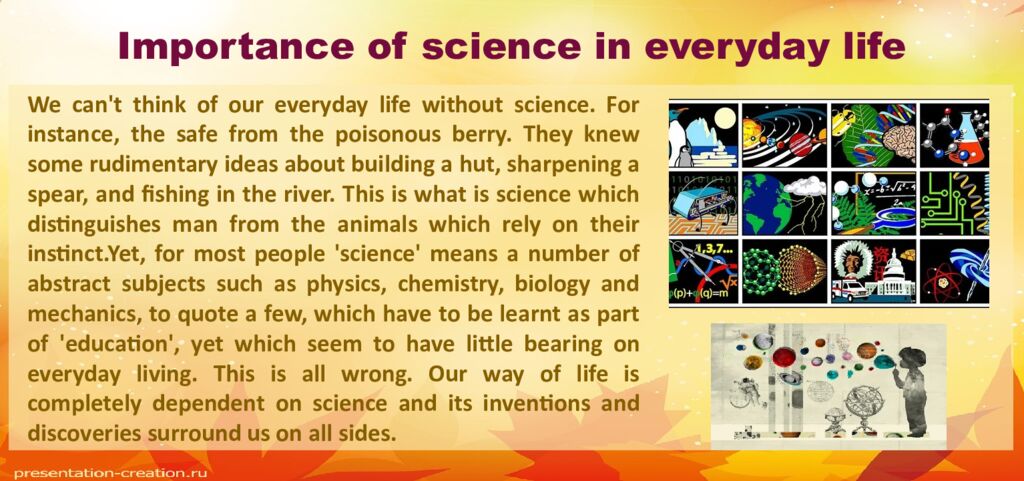
Science's role in society is fundamental to societal progress, providing the knowledge and tools to improve health, communication, and well-being, and informing public policy and personal decisions. It drives economic growth and competitiveness, offers solutions to global challenges like disease and climate change, and fosters critical, evidence-based thinking. While science provides powerful tools for betterment, its application requires ethical considerations and a responsible approach to ensure its benefits are shared equitably.
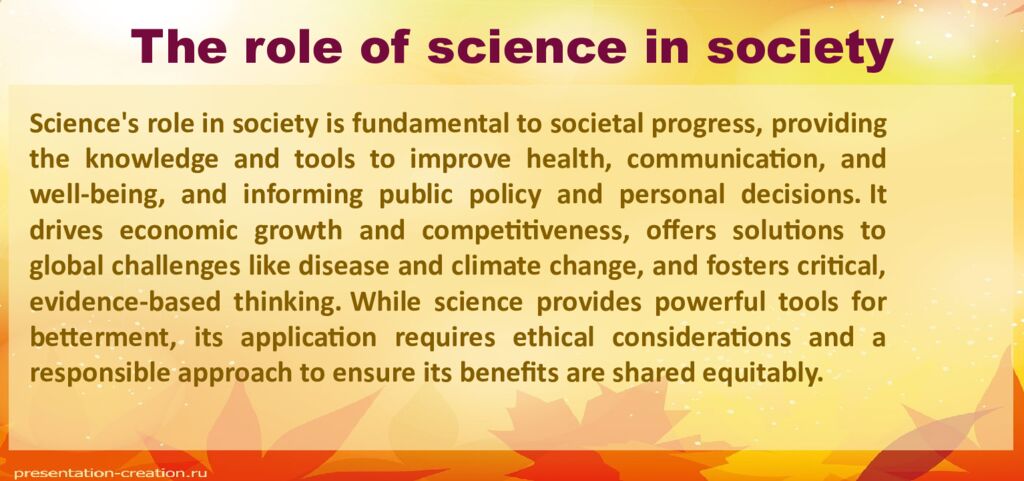
Health and Medicine : Advances in science have led to longer, healthier lives through new medicines, vaccines, and diagnostic tools, improving public health and alleviating suffering. Daily Life : Science underpins many aspects of daily life, from the technology that enables modern communication and transportation to the methods for producing food and energy.
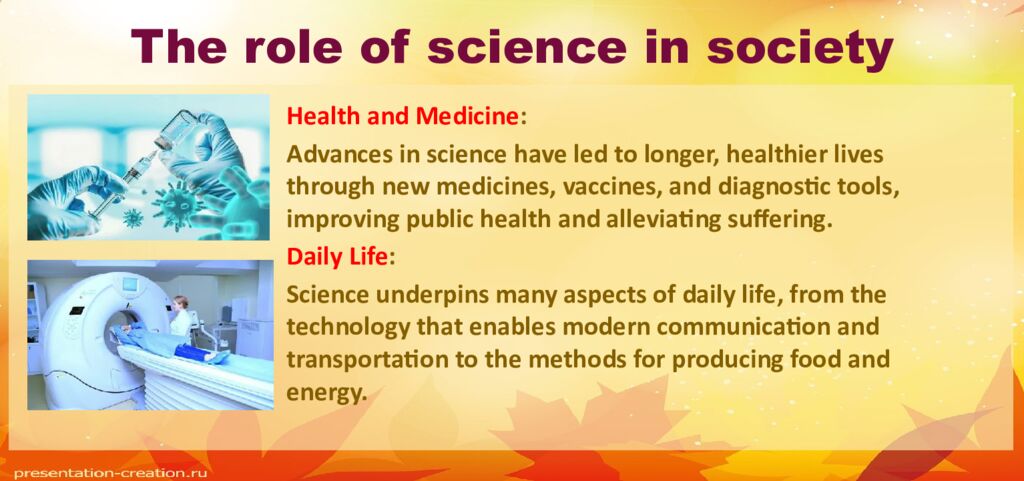
Driving Societal and Economic Development Innovation and Knowledge: Science is a critical source of knowledge, fostering innovation and contributing to economic competitiveness on a global scale. Economic Growth: Scientific discoveries and technological applications have transformed economies by enabling large-scale production of goods and services, creating new industries and sectors.
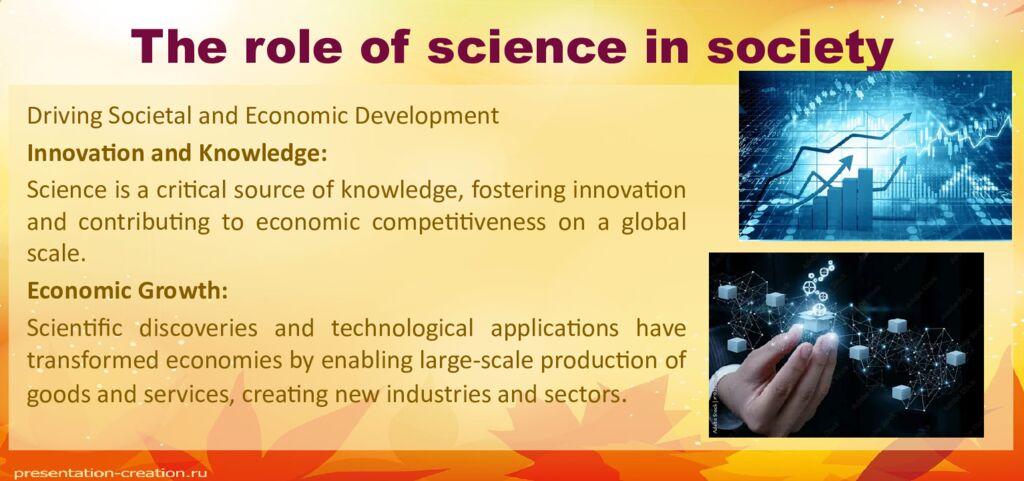
Informing Decision-Making Public Policy: Scientific knowledge informs and guides public policy on critical issues such as energy, conservation, agriculture, and health, helping to shape more effective solutions. Critical Thinking: The scientific method, with its emphasis on rational thinking and evidence, promotes a more critical and objective approach to problem-solving in society.
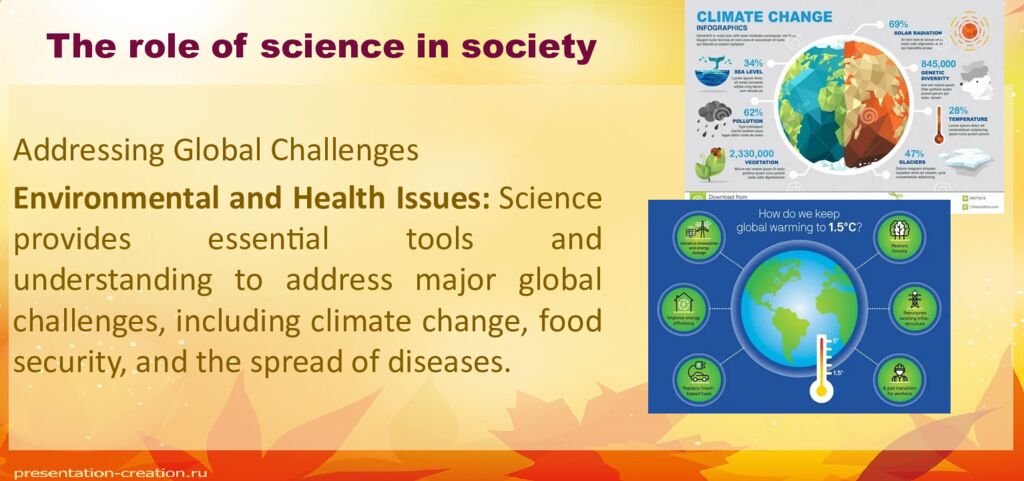
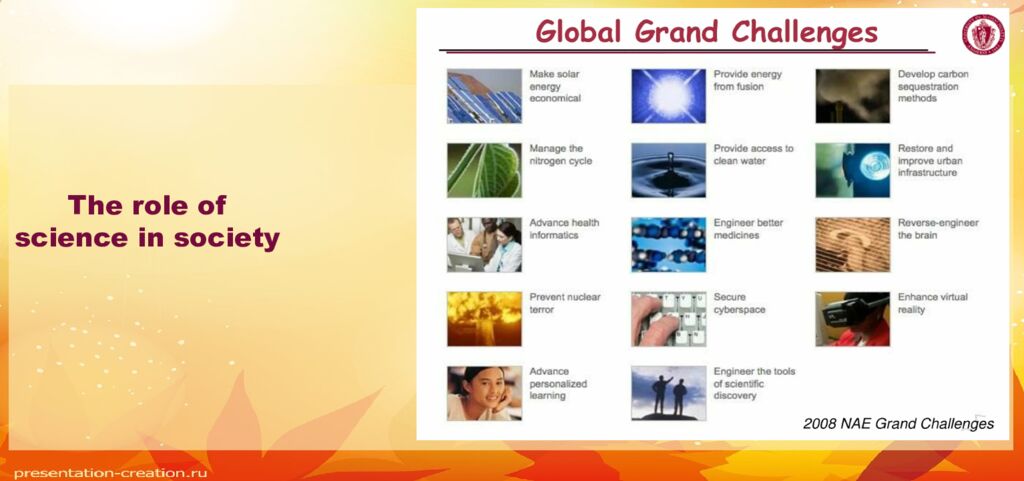
Addressing Global Challenges Environmental and Health Issues: Science provides essential tools and understanding to address major global challenges, including climate change, food security, and the spread of diseases.
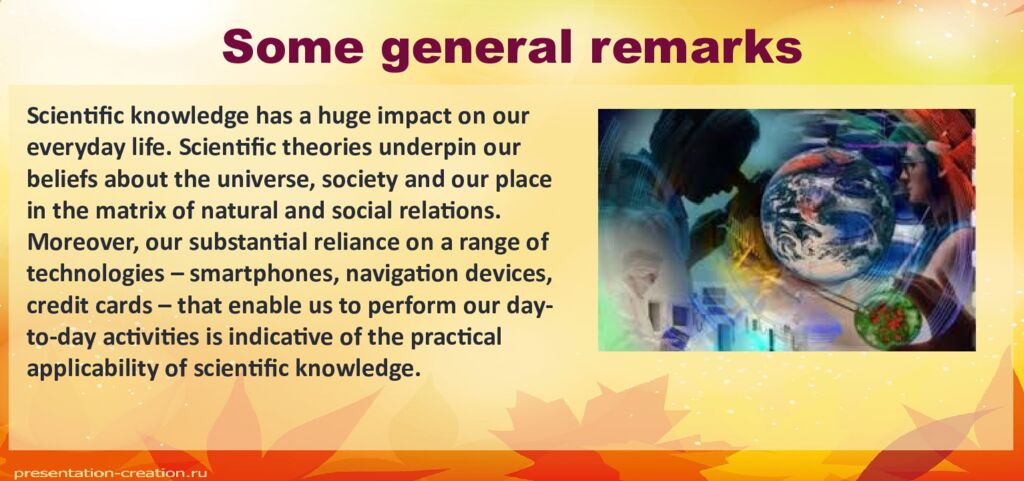
Scientific knowledge has a huge impact on our everyday life. Scientific theories underpin our beliefs about the universe, society and our place in the matrix of natural and social relations. Moreover, our substantial reliance on a range of technologies – smartphones, navigation devices, credit cards – that enable us to perform our day-to-day activities is indicative of the practical applicability of scientific knowledge. Some general remarks
Science, and the theoretical and practical knowledge associated with it, has its origins in European civilization, but its image as an effective method of investigating both natural and social phenomena has spread far beyond the “Old Continent”, i.e. Europe. Even today, products or activities are often described as “scientific” (or “scientifically proven” etc.) in marketing as a means of highlighting their reliability and effectiveness. There is a widespread social awareness of the importance, significance and brilliance of science, although there are exceptions. Science is commonly believed to produce knowledge, which has traditionally been associated with justified true belief. Nonetheless, one can always find individuals, or even organized groups, that contest or reject the results of scientific inquiry, all the more so if they don’t fit in with their personal (religious or ideological) beliefs. Some general remarks
Our task is to critically examine the scope and limits of scientific inquiry generally and to look at how scientific methods are used to solve different kinds of epistemic problems. It is not enough to explore science merely in terms of its end result – scientific knowledge. Methodologically, the most important aspect of science is the specific way in which it investigates its object. To better understand science’s historical successes, but also its failures, we need to look at the main components of scientific research. Some general remarks
The capacity to think critically about one’s scientific discipline, the ability to identify and analyze the general assumptions underpinning it, and the capacity to recognize the methodological purposes of a method are skills that are prized not only by those wishing to thoroughly understand the discipline they study, but also by those interested in the (general) possibilities and frontiers of knowledge provided by science. Those who study social science and the humanities (among others) typically have to learn, understand and develop the ability to critically appraise the system of knowledge the discipline engages with, whilst also learning about the principles and methods that generated it. Although disciplines vary in terms of what is studied (the object of investigation), the goals pursued, and their research methods, this variety does not preclude us from studying the methodological features they share Some general remarks
Modern science is commonly divided into three major branches that consist of the natural sciences, social sciences, and formal sciences. Each of these branches comprise various specialized yet overlapping scientific disciplines that often possess their own nomenclature and expertise. Both natural and social sciences are empirical sciences as their knowledge is based on empirical observations and is capable of being tested for its validity by other researchers working under the same conditions. Branches of science
Science Formal science Empirical sciences Natural science Social science Foundation Logic; Mathematics; Statistics Physics; Chemistry; Biology; Earth science; Space science Economics; Political science; Sociology; Psychology Application Computer science Engineering; Agricultural science; Medicine; Dentistry; Pharmacy Business administration; Jurisprudence; Pedagogy
SCIENCE FORMAL EMPI RICAL Natural science Social science FOUNDATION Logic; Mathematics; Statistics Physics; Chemistry; Biology ; Earth science; Space science Economics; Political science; Sociology; Psychology APPLICATION Computer science Engineering; Agricultural science; Medicine; Dentistry; Pharmacy Business administration; Jurisprudence; Pedagogy Branches of science There are also closely related disciplines that use science, such as engineering and medicine, which are sometimes described as applied sciences. The relationships between the branches of science are summarized by the following table.
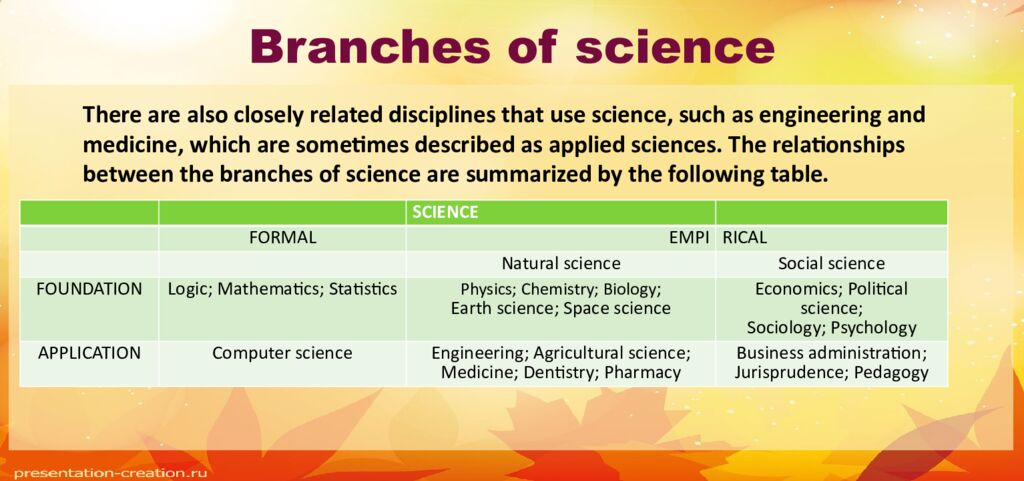
The scale of the Universe mapped to branches of science and showing how one system is built atop the next through the hierarchy of the sciences.
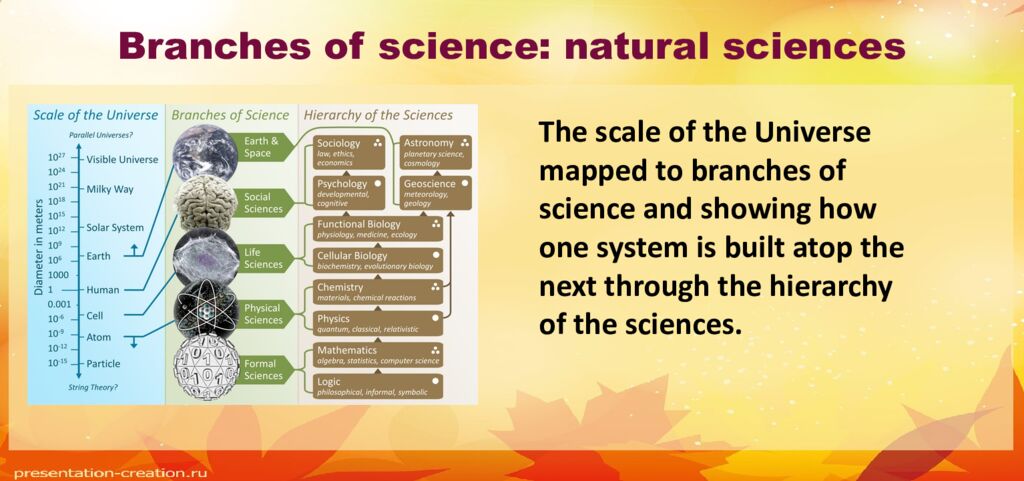
Natural science is concerned with the description, prediction, and understanding of natural phenomena based on empirical evidence from observation and experimentation. It can be divided into two main branches: life science (or biological science) and physical science. Physical science is subdivided into branches, including physics, chemistry, astronomy and earth science. These two branches may be further divided into more specialized disciplines. Branches of science: natural sciences
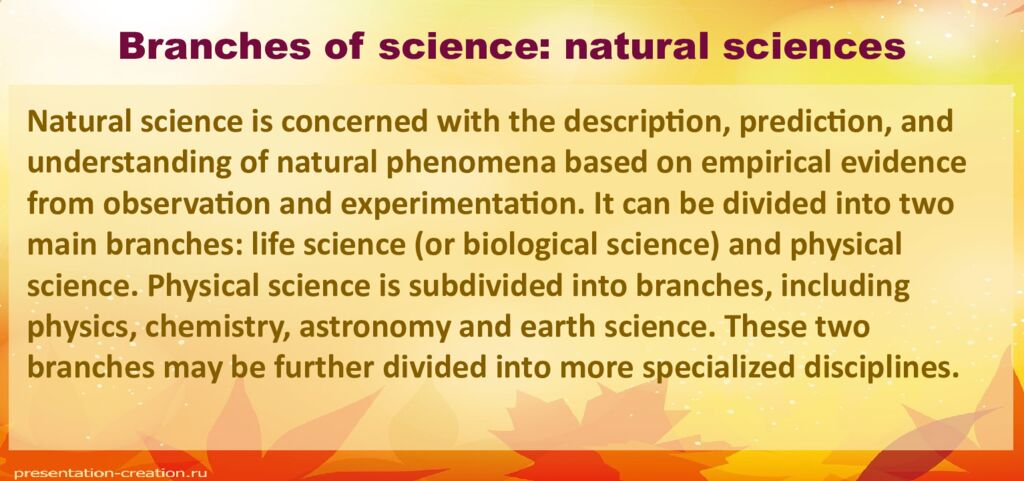
Modern natural science is the successor to the natural philosophy that began in Ancient Greece. Galileo, Descartes, Bacon, and Newton debated the benefits of using approaches which were more mathematical and more experimental in a methodical way. Still, philosophical perspectives, conjectures, and presuppositions, often overlooked, remain necessary in natural science. Systematic data collection, including discovery science, succeeded natural history, which emerged in the 16th century by describing and classifying plants, animals, minerals, and so on. Today, “natural history” suggests observational descriptions aimed at popular audiences. Branches of science: natural sciences
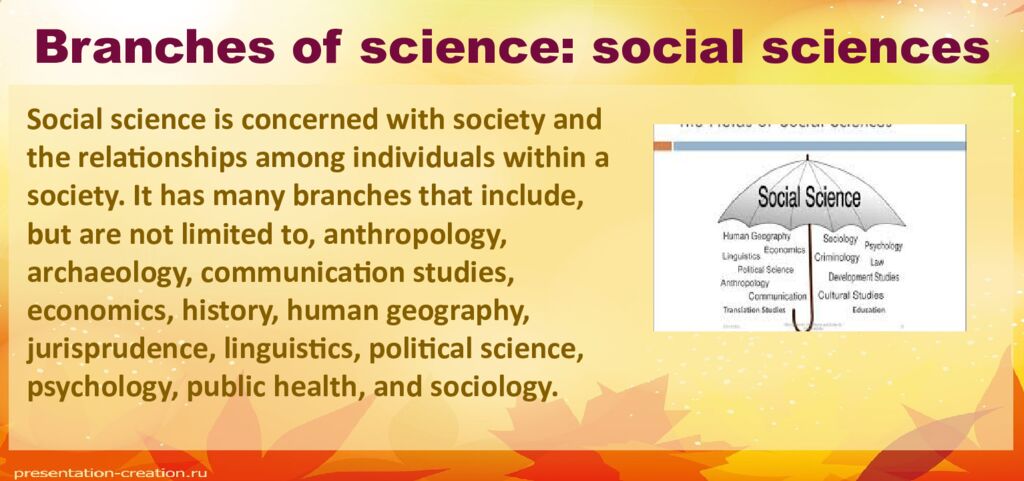
Social science is concerned with society and the relationships among individuals within a society. It has many branches that include, but are not limited to, anthropology, archaeology, communication studies, economics, history, human geography, jurisprudence, linguistics, political science, psychology, public health, and sociology. Branches of science: social sciences
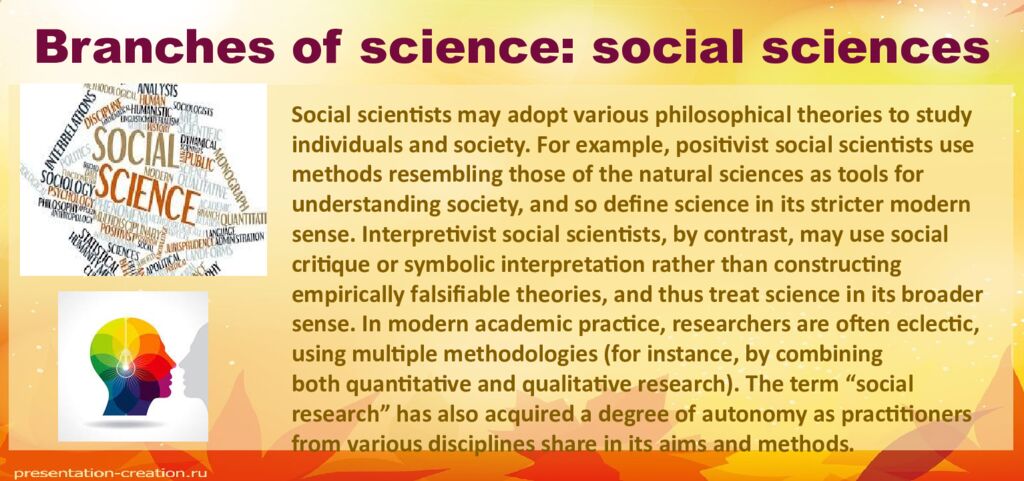
Social scientists may adopt various philosophical theories to study individuals and society. For example, positivist social scientists use methods resembling those of the natural sciences as tools for understanding society, and so define science in its stricter modern sense. Interpretivist social scientists, by contrast, may use social critique or symbolic interpretation rather than constructing empirically falsifiable theories, and thus treat science in its broader sense. In modern academic practice, researchers are often eclectic, using multiple methodologies (for instance, by combining both quantitative and qualitative research). The term “social research” has also acquired a degree of autonomy as practitioners from various disciplines share in its aims and methods. Branches of science: social sciences
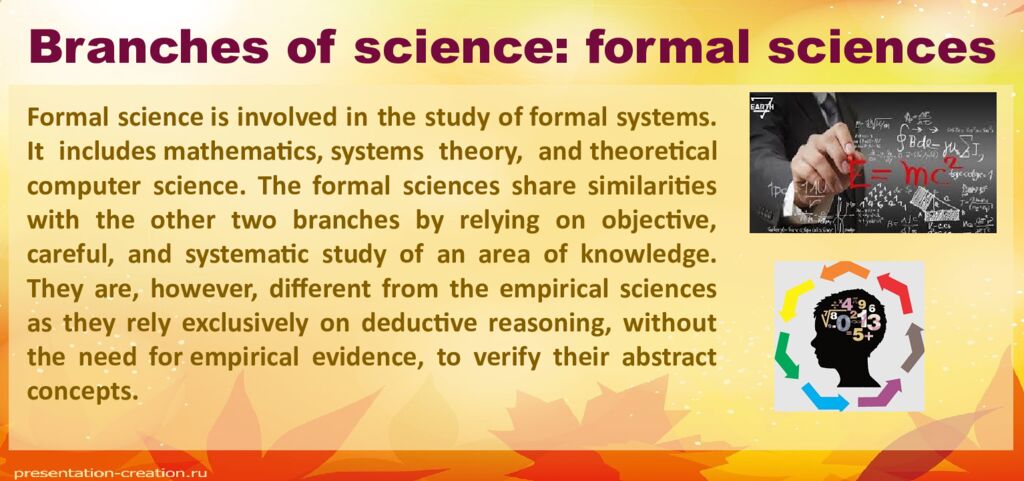
Formal science is involved in the study of formal systems. It includes mathematics, systems theory, and theoretical computer science. The formal sciences share similarities with the other two branches by relying on objective, careful, and systematic study of an area of knowledge. They are, however, different from the empirical sciences as they rely exclusively on deductive reasoning, without the need for empirical evidence, to verify their abstract concepts. Branches of science: formal sciences
The formal sciences are therefore a priori disciplines and because of this, there is disagreement on whether they actually constitute a science. Nevertheless, the formal sciences play an important role in the empirical sciences. Calculus, for example, was initially invented to understand motion in physics. Natural and social sciences that rely heavily on mathematical applications include mathematical physics, mathematical chemistry, mathematical biology, mathematical finance, and mathematical economics. Branches of science: formal sciences
Distinctive features of science include its reliance on empirical evidence from observation and experimentation, a systematic approach using methods like the scientific method, the principle of objectivity in seeking facts as they are, the requirement for replicability and verifiability by other scientists, and falsifiability, meaning theories must be disprovable. Science is also characterized as progressive and self-correcting, with its knowledge being tentative, provisional, and constantly open to revision.
Here are the key distinctive features of science: Empirical Evidence : Science is based on observable and measurable evidence collected through systematic observation and controlled experiments, rather than assumptions or intuition. Systematic Approach : Scientific inquiry follows structured procedures, often including the scientific method, for formulating hypotheses, collecting data, and drawing conclusions. Distinctive features of science
Objectivity : Scientists strive to be impartial and base their conclusions on facts as they are, free from personal biases or wishes. Replicability and Verifiability : Scientific findings must be reproducible by other researchers under similar conditions, allowing them to verify the accuracy and reliability of the original observations. Distinctive features of science
Public Knowledge : Scientific knowledge is shared openly with the community, allowing for peer review, collaboration, and further investigation by other scientists. Theoretical Frameworks : Science involves the construction of theories that provide comprehensive explanations for observed phenomena and can be used for making predictions. Non- dogmatic : Science does not deal in absolute, unchangeable truths but rather in tentative conclusions based on the best available evidence, remaining open to new information. Distinctive features of science
E'TIBORINGIZ UCHUN RAHMAT !