

Tutorial 10. The Open Economy: the Mundell-Fleming Model
The Mundell–Fleming model is an economic model that explains how a country’s economy works when it’s open to international trade and capital flows (that means, when money and goods can move across borders). It’s like an extension of the IS–LM model, but for an open economy.
It helps answer: How do fiscal policy (government spending/taxes) and monetary policy (interest rates, money supply) affect output, exchange rates, and interest rates in an open economy?
IS curve – shows combinations of interest rates and output (GDP) where goods markets are in equilibrium. LM curve – shows combinations of interest rates and output where the money market is in equilibrium.
BP ( or FE) curve – shows combinations where the balance of payments ( international money flows ) is in equilibrium. If capital is free to move across countries, interest rate differences affect capital flows.
1. Fixed Exchange Rate The government or central bank keeps the currency value constant (e.g., 1 USD = 100 TJS). If demand/supply for currency changes, the central bank intervenes by buying/selling reserves. Fiscal policy (G, T) becomes powerful — it can increase output. Monetary policy is weak — central bank actions are limited by the need to keep the exchange rate fixed.
The currency’s value is determined by market forces (demand & supply for foreign exchange). Monetary policy becomes powerful — changing interest rates affects exchange rates and net exports. Fiscal policy is weak — increased spending raises interest rates, attracting capital inflows, appreciating the currency, and reducing net exports.
How interest rates, exchange rates, and output interact in an open economy. Why policy effectiveness depends on the exchange rate system. How capital mobility (how easily money moves across borders) changes policy outcomes.
If a small open economy with a flexible exchange rate is experiencing a recession, what will automatically happen over time to its trade balance, foreign exchange rate, and national output? Illustrate graphically.
Answer : Say that Y(LR) is the long run output for the economy, while Y1 is where the economy is right now. Then, what must happen is PRICES WILL FALL – this of course means that real money balances rise, implying a rightward shift in the LM* curve. Note that this also implies a decrease in the real exchange rate.

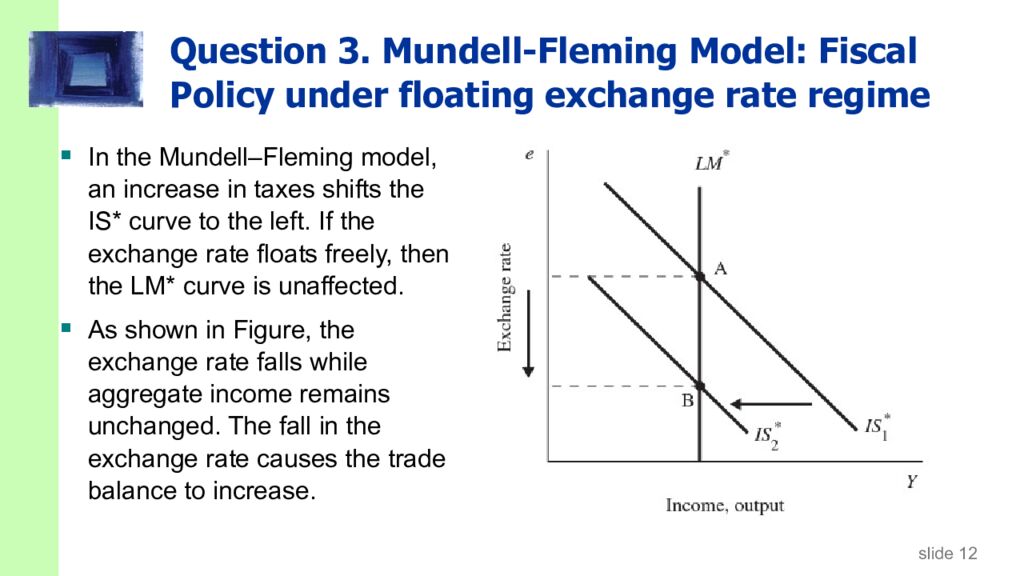
In the Mundell–Fleming model, what happens to the exchange rate, aggregate income, and trade balance if an increase in taxes occurs?
In the Mundell–Fleming model, an increase in taxes shifts the IS* curve to the left. If the exchange rate floats freely, then the LM* curve is unaffected. As shown in Figure, the exchange rate falls while aggregate income remains unchanged. The fall in the exchange rate causes the trade balance to increase.
In the Mundell–Fleming model, what happens to the aggregate income, and trade balance if an increase in taxes occurs?
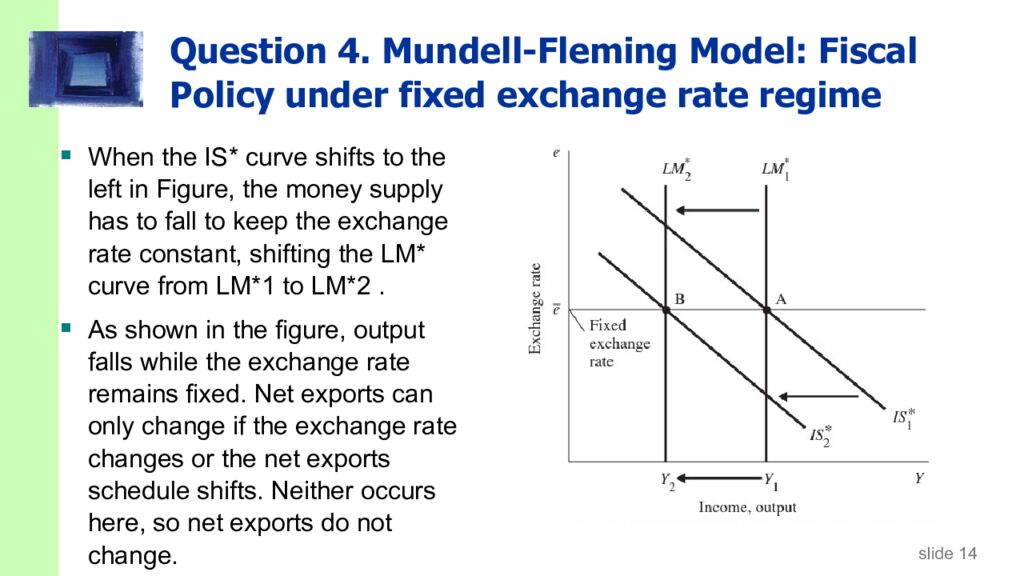
When the IS* curve shifts to the left in Figure, the money supply has to fall to keep the exchange rate constant, shifting the LM* curve from LM*1 to LM*2. As shown in the figure, output falls while the exchange rate remains fixed. Net exports can only change if the exchange rate changes or the net exports schedule shifts. Neither occurs here, so net exports do not change.
From the answers to the questions 3 and 4, what we may conclude about fiscal policy effectiveness: is it effective that under fixed exchange rates or under floating exchange rates?

From the answers to the questions 3 and 4, we conclude that in an open economy, fiscal policy is effective at influencing output under fixed exchange rates but ineffective under floating exchange rates.
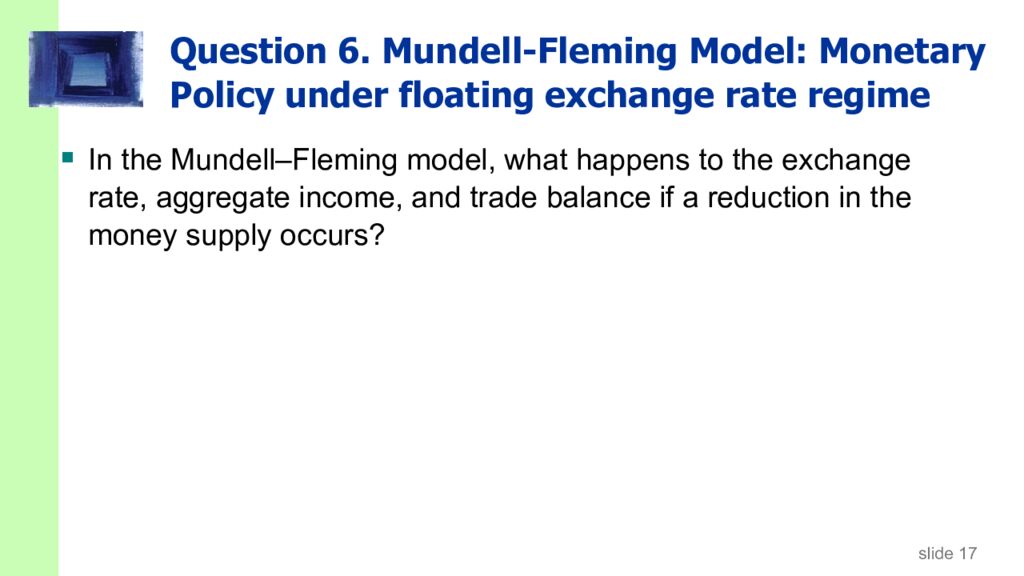
In the Mundell–Fleming model, what happens to the exchange rate, aggregate income, and trade balance if a reduction in the money supply occurs?
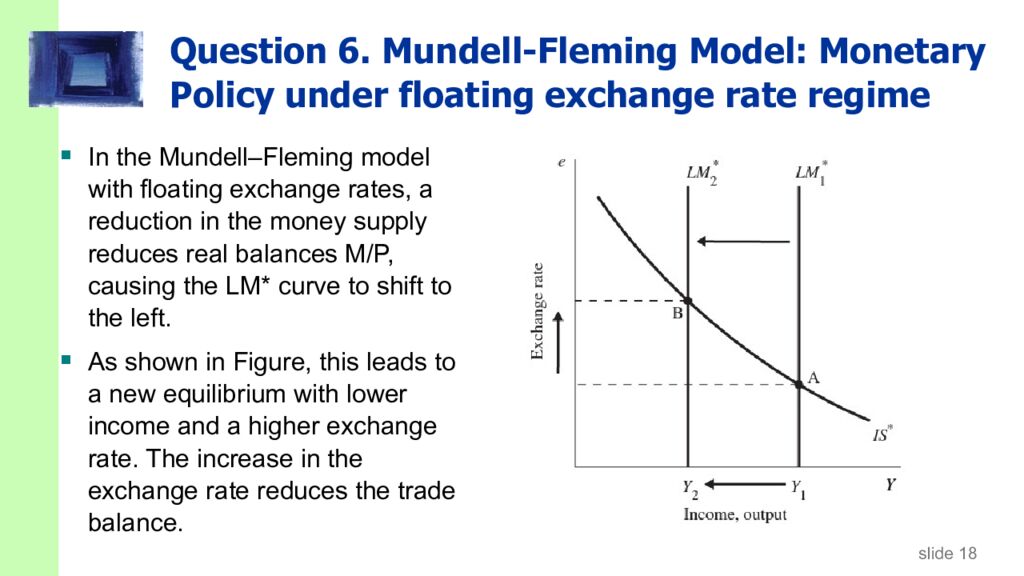
In the Mundell–Fleming model with floating exchange rates, a reduction in the money supply reduces real balances M/P, causing the LM* curve to shift to the left. As shown in Figure, this leads to a new equilibrium with lower income and a higher exchange rate. The increase in the exchange rate reduces the trade balance.
In the Mundell–Fleming model, what happens to the aggregate income, and trade balance if a reduction in the money supply occurs?
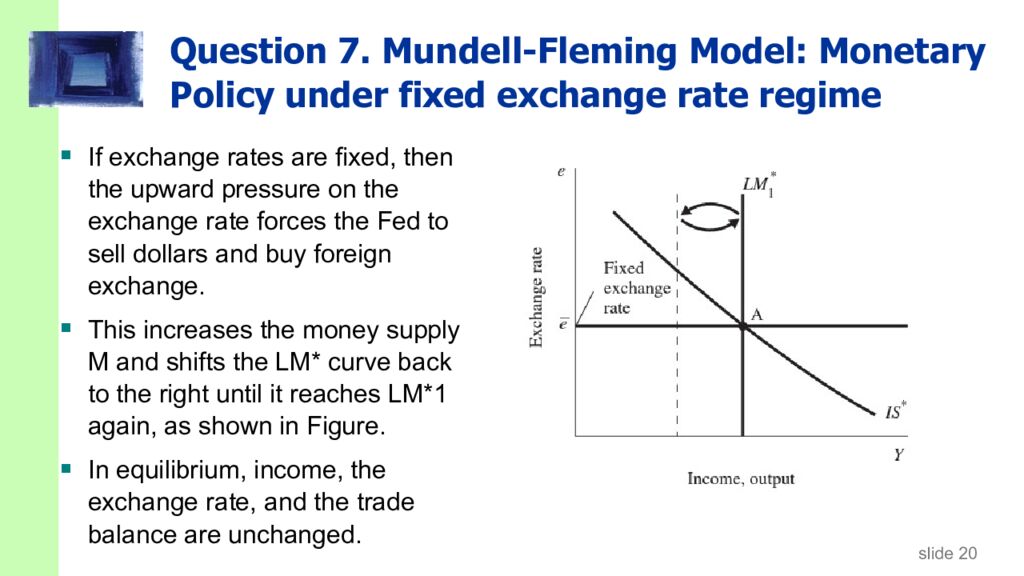
If exchange rates are fixed, then the upward pressure on the exchange rate forces the Fed to sell dollars and buy foreign exchange. This increases the money supply M and shifts the LM* curve back to the right until it reaches LM*1 again, as shown in Figure. In equilibrium, income, the exchange rate, and the trade balance are unchanged.
From the answers to the questions 3 and 4, what we may conclude about monetary policy effectiveness: is it effective that under fixed exchange rates or under floating exchange rates?
From the answers to the questions 3 and 4, we conclude that in an open economy, monetary policy is effective at influencing output under floating exchange rates but impossible under fixed exchange rates.
In the Mundell–Fleming model, what happens to the exchange rate, aggregate income, and trade balance if a removing a quota on imported cars occurs?
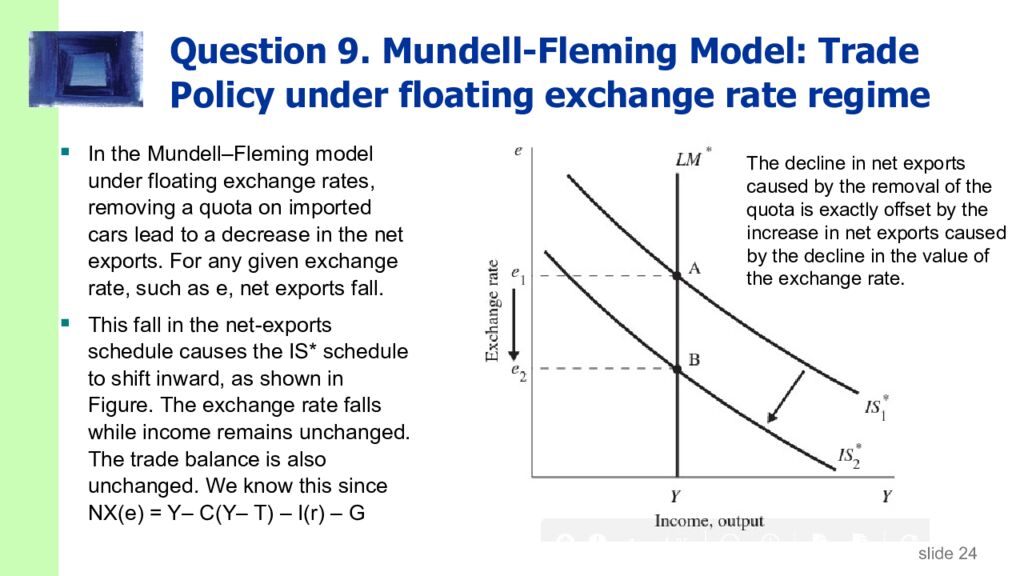
In the Mundell–Fleming model under floating exchange rates, removing a quota on imported cars lead to a decrease in the net exports. For any given exchange rate, such as e, net exports fall. This fall in the net-exports schedule causes the IS* schedule to shift inward, as shown in Figure. The exchange rate falls while income remains unchanged. The trade balance is also unchanged. We know this since NX(e) = Y– C(Y– T) – I(r) – G The decline in net exports caused by the removal of the quota is exactly offset by the increase in net exports caused by the decline in the value of the exchange rate.
In the Mundell–Fleming model, what happens to the exchange rate, aggregate income, and trade balance if a removing a quota on imported cars occurs?
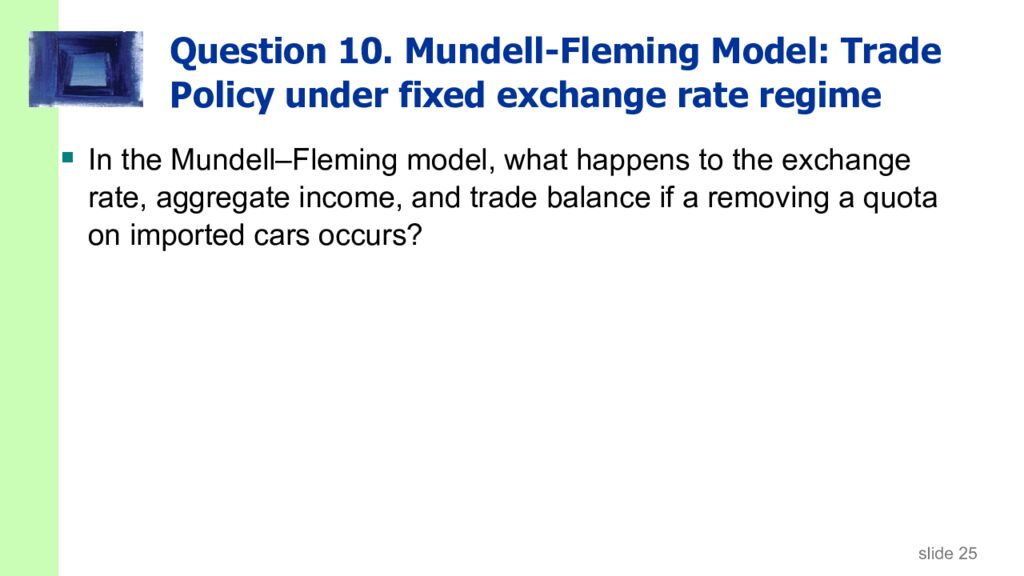
If there are fixed exchange rates, then the shift in the IS* curve puts downward pressure on the exchange rate, as above. In order to keep the exchange rate fixed, the Fed is forced to buy dollars and sell foreign exchange. This shifts the LM* curve to the left, as shown in Figure. In equilibrium, income is lower and the exchange rate is unchanged. The trade balance falls; we know this because net exports are lower at any level of the exchange rate.

The impossible trinity states that it is impossible for a nation to have free capital flows, a fixed exchange rate, and independent monetary policy. In other words, you can only have two of the three. If you want free capital flows and an independent monetary policy, then you cannot also peg the exchange rate. If you want a fixed exchange rate and free capital flows, then you cannot have independent monetary policy. If you want to have independent monetary policy and a fixed exchange rate, then you need to restrict capital flows.
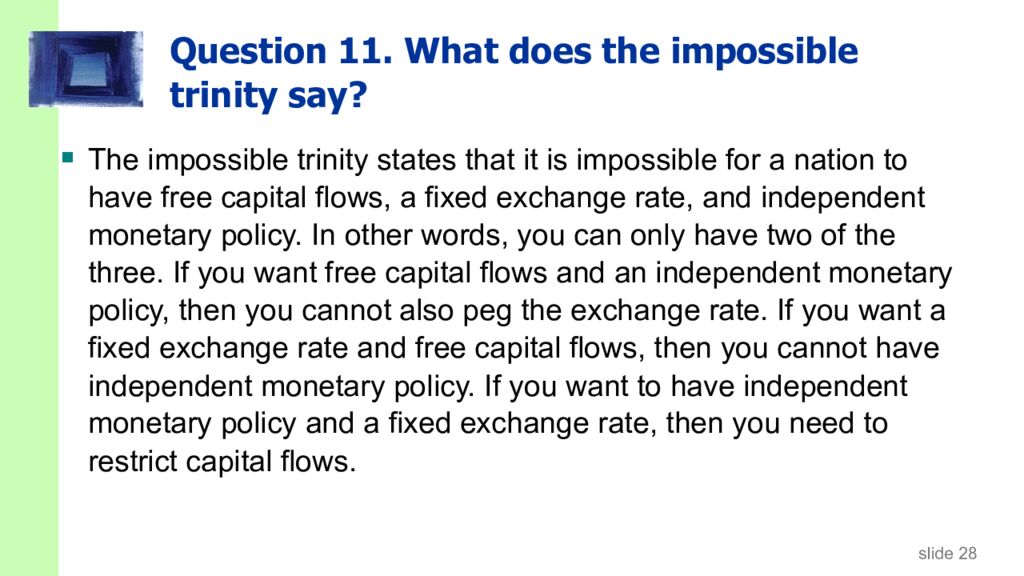

U.S. goods more expensive to Mexicans U.S. firms lost revenue Hundreds of bankruptcies along U.S.-Mexican border Mexican assets worth less in dollars Reduced wealth of millions of U.S. citizens
In the early 1990s, Mexico was an attractive place for foreign investment. During 1994, political developments caused an increase in Mexico’s risk premium ( ): peasant uprising in Chiapas assassination of leading presidential candidate Another factor: The Federal Reserve raised U.S. interest rates several times during 1994 to prevent U.S. inflation. ( r * > 0)
These events put downward pressure on the peso. Mexico’s central bank had repeatedly promised foreign investors that it would not allow the peso’s value to fall, so it bought pesos and sold dollars to “prop up” the peso exchange rate. Doing this requires that Mexico’s central bank have adequate reserves of dollars. Did it?
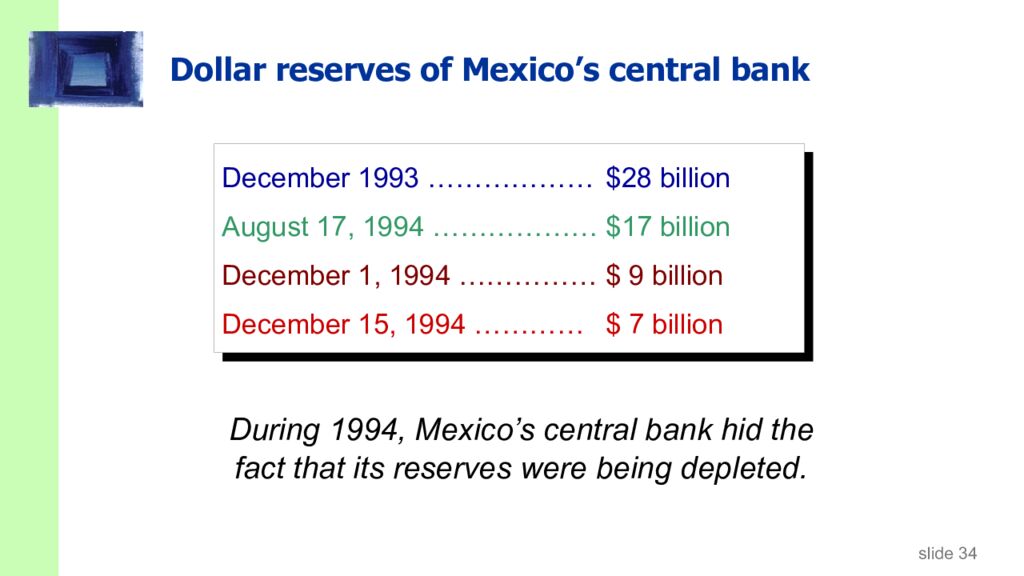
December 1993 ……………… $28 billion August 17, 1994 ……………… $17 billion December 1, 1994 …………… $ 9 billion December 15, 1994 ………… $ 7 billion During 1994, Mexico’s central bank hid the fact that its reserves were being depleted.
Dec. 20: Mexico devalues the peso by 13% (fixes e at 25 cents instead of 29 cents) Investors are SHOCKED! – they had no idea Mexico was running out of reserves. , i nvestors dump their Mexican assets and pull their capital out of Mexico. Dec. 22: central bank’s reserves nearly gone. It abandons the fixed rate and lets e float. In a week, e falls another 30%.
1995: U.S. & IMF set up $50b line of credit to provide loan guarantees to Mexico’s govt. This helped restore confidence in Mexico, reduced the risk premium. After a hard recession in 1995, Mexico began a strong recovery from the crisis.
Problems in the banking system eroded international confidence in SE Asian economies. Risk premiums and interest rates rose. Stock prices fell as foreign investors sold assets and pulled their capital out. Falling stock prices reduced the value of collateral used for bank loans, increasing default rates, which exacerbated the crisis. Capital outflows depressed exchange rates.
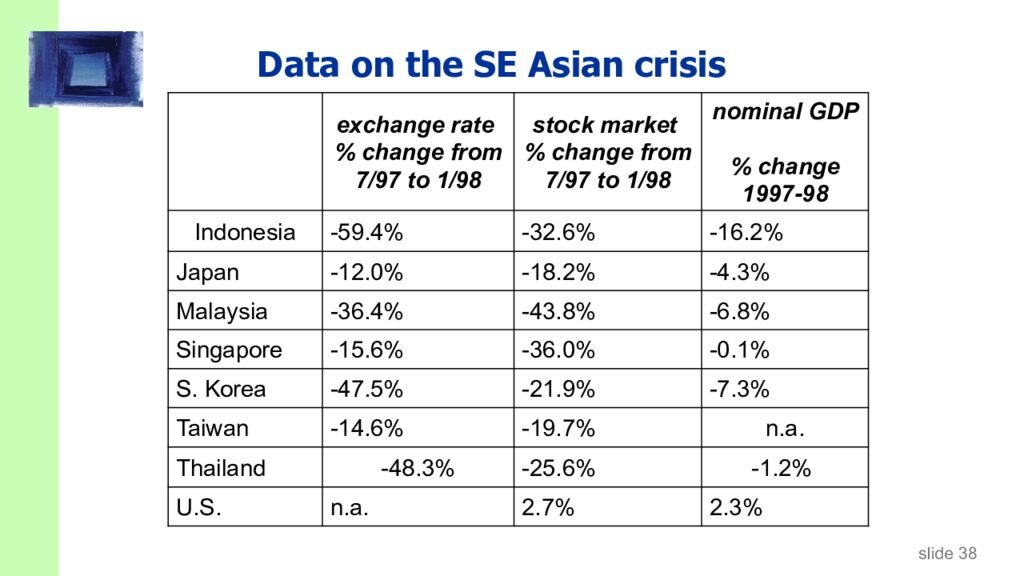
exchange rate % change from 7/97 to 1/98 stock market % change from 7/97 to 1/98 nominal GDP % change 1997-98 Indonesia -59.4% -32.6% -16.2% Japan -12.0% -18.2% -4.3% Malaysia -36.4% -43.8% -6.8% Singapore -15.6% -36.0% -0.1% S. Korea -47.5% -21.9% -7.3% Taiwan -14.6% -19.7% n.a. Thailand -48.3% -25.6% -1.2% U.S. n.a. 2.7% 2.3%
1995-2005: China fixed its exchange rate at 8.28 yuan per dollar, and restricted capital flows. Many observers believed that the yuan was significantly undervalued, as China was accumulating large dollar reserves. U.S. producers complained that China’s cheap yuan gave Chinese producers an unfair advantage. President Bush asked China to let its currency float; Others in the U.S. wanted tariffs on Chinese goods.
If China lets the yuan float, it may indeed appreciate. However, if China also allows greater capital mobility, then Chinese citizens may start moving their savings abroad. Such capital outflows could cause the yuan to depreciate rather than appreciate.